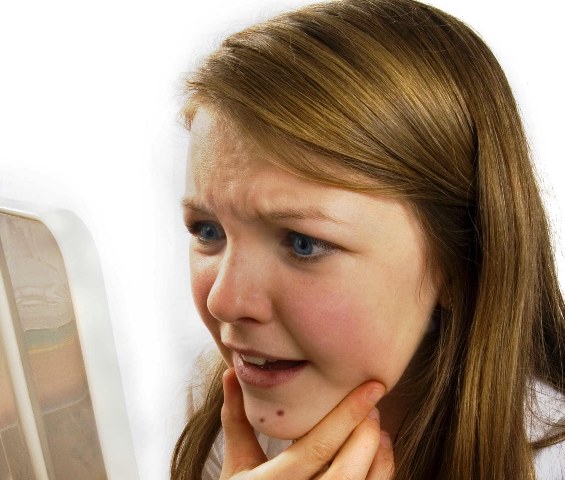
When you hit in adolescent period, you will at some point have acne. Sadly, this continues when you become an adult. So, what you have to do is prepare and take care of your skin. There many products guaranteeing protection of your skin and simple ways to keep your skin healthy. And if you are to spend, there are some promising acne treatments that are on horizon from sub-antimicrobial treatments -- low-dose antibiotics -- to vitamins and light therapy.

Research by a joint team at the University of Pittsburgh and the University of California at Los Angeles has found that the "good" bacteria and "bad" bacteria found on people's skin and in their intestines can determine whether they have acne or not.

But don't expect a miracle cream just yet, said Huiying Li, one of the lead researchers in the study.
"We've still got years of work to do before anything appears on the market," she said. There are, at any one time, 40 million to 50 million people suffering from acne, and it's not clear why the number of adults are growing, said a report from the American Academy of Dermatology -- perhaps just more adults seeking treatment.

Adult acne affects 45 percent of women aged 21 to 30, 26 percent of women aged 31 to 40 and 12 percent of women aged 41 to 50, according to a Massachusetts General Hospital study in 2012.
Moreover, acne vulgaris, driven by hormones, mostly disappeared by age 18, but these days lasts on average to about age 28, said Lisa Pawelski, a dermatologist based in Monroeville.
For some women, that type of acne never goes away, but it does become less severe. For others, it comes as a nasty surprise just when they're preparing to battle aging skin.

Jean Camp was lucky enough to have a clear complexion as a teenager but now, at 32, is suffering from a different type of acne known as papulopustular rosacea -- pink bumps, or papules, and pustules, more commonly known in acne lingo as whiteheads.
She even remembers the date she realized she had it: March 1, 2010.
"I have people asking me what's wrong with my face," said Ms. Camp. "I can never wear makeup, because it doesn't cover up the pimples and only irritates me more. I don't think it's fair."

These two different kinds of acne can be determined by location: teenage acne vulgaris can be all over the face and back, while the adult version is mostly along the jawline. And the rosacea form can be found mostly across the center of the face, on the cheeks and around the nose.
"Wrinkles and acne are the diabolical duo," said Suzan Obagi, assistant professor of dermatology at the University of Pittsburgh School of Medicine and director of the UPMC Cosmetic Surgery and Skin Health Center. Certain treatments present a special challenge with older skin, she said, which is thinner and drier and can respond poorly to the high concentrations of benzoyl peroxide teenagers slather all over their faces.

Sitting in her sunlit offices in Shadyside, she sees no shortage of older women patients "who are not going to outgrow this kind of acne," and, perhaps fittingly, she is turning to light as one of her options.Source: http://www.post-gazette.com/stories/news/health/more-and-more-women-are-battling-breakouts-that-they-might-have-imagined-was-just-an-adolescent-scourge-685441/#ixzz2S1wHbCpo